The Framework
Two landscapes and two kinds of gap. Identifying which kind of gap a market has is the first decision that shapes cost-effectiveness.
Two Landscapes
The two landscapes are the framework's central metaphor. Whether they align determines what kind of intervention a market needs.
The Financial Landscape: What Markets See
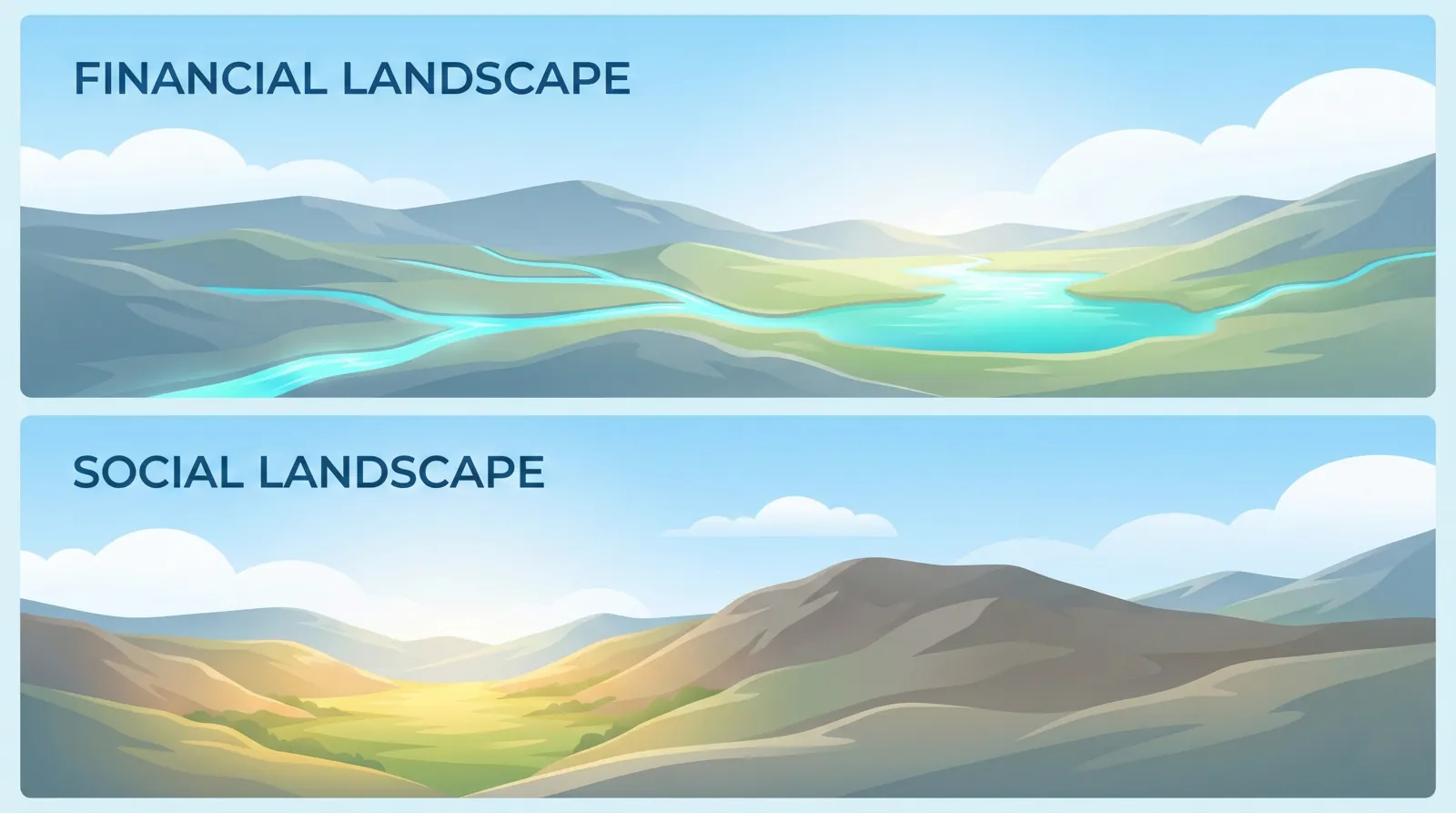
Imagine a topographical map where elevation represents profitability. Low elevation means high profit, and high elevation means low profit or losses. Capital, money seeking returns, flows like water across this terrain and pools at the low points.
This landscape is shaped by costs, prices, regulations and risks, so mapping it shows where money will flow.
The Social Landscape: What We Want
Now imagine a second map over the same ground, where low elevation means high social value: affordable medicine reaching everyone who needs it, or clean energy replacing fossil fuels.
Prices do not reflect this landscape, whose shape comes from everything society values, including effects that never appear in a price.
Do the Landscapes Align?
Laid on top of each other, the maps are often similar, which is why markets work as well as they do. Sometimes they are inverted, with the financial low point on high ground in the social landscape. Even where they align, capital may not have reached the shared low point.
Diagnosing a market means finding the low points of each landscape and asking why capital has not reached the one we want.
The profitable destination is also the good one, and capital has reached it.
The market works and no intervention is needed.
The profitable destination is also the good one, but capital cannot get there on its own because of risk, uncertainty or a failure to coordinate.
A Transitional Access Gap. Our work is navigation: creating a temporary path through the barrier.
The profitable destination is not the good one, so capital flows efficiently to the wrong place or never reaches the right one.
A Structural Misalignment. Our work is terraforming: reshaping the financial landscape and keeping it reshaped.
Two Kinds of Gap, Two Kinds of Solution
There are two fundamental kinds of gap between what a market does and what we want it to do. Which one applies determines what to use, how long to intervene and what success looks like.
The Walk-Away Test
If a fully successful intervention is withdrawn and the market holds its new position, the gap was transitional, and if the market slides back, the gap was structural. The test asks whether the outcome we want is self-enforcing, which shows whether the intervention can end and so whether impact can continue after spending stops.
Answering it takes evidence on how unit cost at scale compares with what the buyers who will remain can sustainably pay, whether new suppliers could enter at that price and whether high volume is even desirable. For novel antibiotics, stewardship aims to keep use low, so a gap that looks transitional is structural.
Landscapes aligned, capital stuck
The destination is good for everyone, but capital can’t reach it without help.

The landscapes agree. The financial and social landscapes share the same global minimum, where investment would be both profitable and beneficial. But capital is trapped in a local minimumLocal Minimum. In the landscape metaphor, a low point where capital has pooled even though a better one exists elsewhere. Capital stays because reaching the better point means crossing a ridge of risk or uncertainty no single actor will cross., stuck behind a ridgeRidge. The barrier of temporary losses between capital's current low point and a better one. A transitional gap is such a ridge, and learning curves wear it down. of risk, uncertainty or coordination failure. Suppliers wait for committed buyers and buyers wait for proven supply, so risk is priced as if the market may never exist.
A temporary path through the ridge lets capital reach the global minimum. Guarantees reduce the perceived barrier, concessional capital bridges the gap, and coordination removes uncertainty. Once there, capital stays, because staying is profitable, so the intervention can be removed.

In 2017, a superior HIV regimen, TLD, was ready to replace older treatments. Generic manufacturers needed demand certainty to invest in capacity, and countries needed assured supply at a predictable price to plan their transitions. The Gates Foundation guaranteed minimum volumes, and the Clinton Health Access Initiative brokered ceiling price agreements of about $75 per patient per year for public buyers in 92 countries.
Why this is transitional: once countries had switched and licensed generic suppliers competed, the market sustained itself without the guarantee. Read the case.
Landscapes misaligned
The market will not sustain the outcome, however well it functions.
The landscapes disagree. The financial landscape has no low point where the social landscape does. The disagreement takes two forms.
The financial low point is a toxic pit, where pollution is profitable because its costs fall on people outside the transaction.
There is no pit. The social low point isn’t low on the financial map, because much of its value goes to people other than the buyer, such as the herd immunity that vaccination gives the unvaccinated or the slower spread of antimicrobial resistance.
The financial landscape can be reshaped to match the social one in two ways, by raising the financial floor of harmful activities through taxes, penalties and regulation, and by lowering the financial floor of beneficial activities through subsidies, outcome payments and other permanent payments.
These changes must be permanent. If they are removed, the landscapes diverge again, so the main design problem is keeping the payer paying.
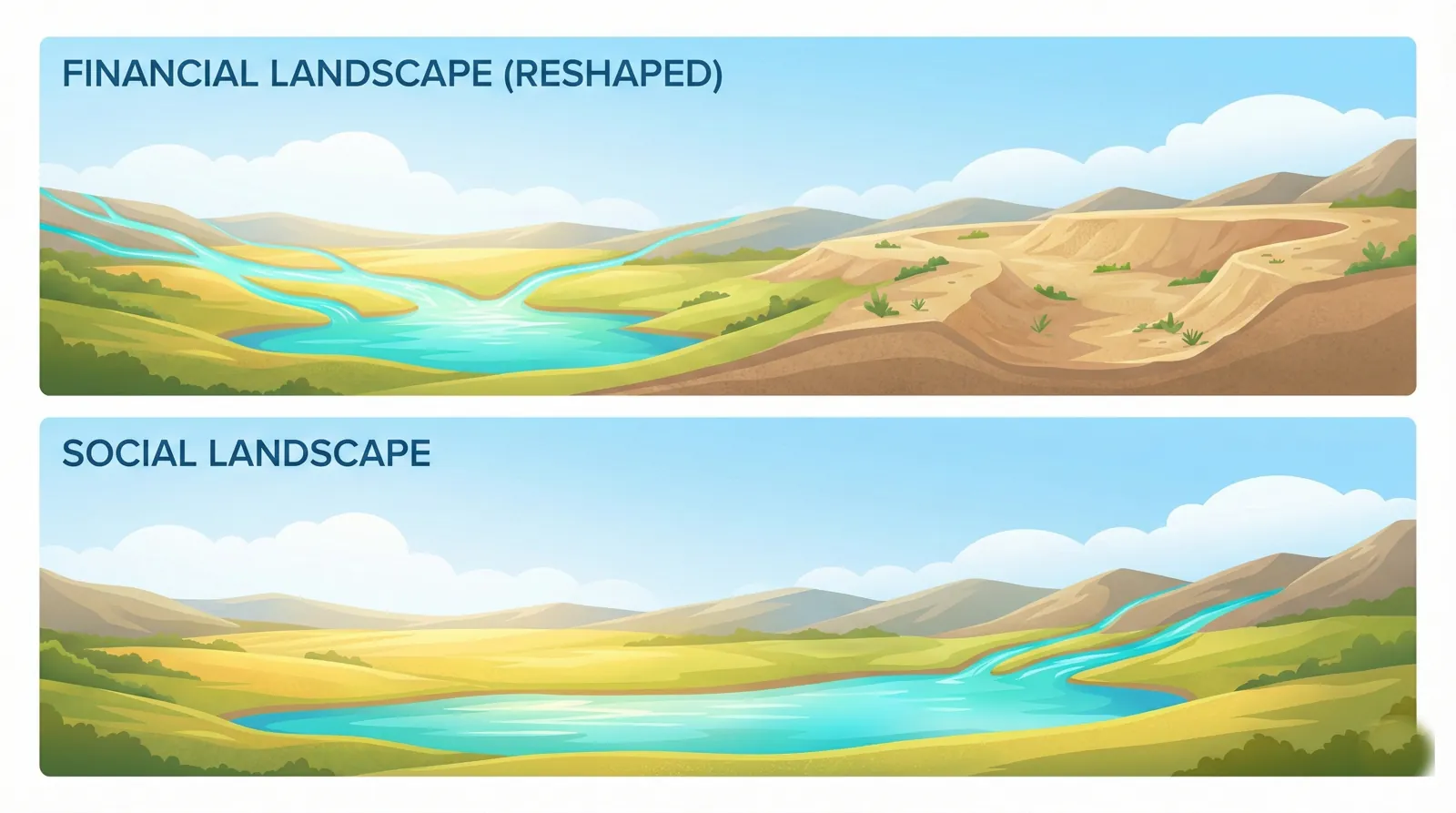
Without intervention, emitting carbon dioxide is free while reducing emissions costs money, so the financial landscape slopes toward pollution. A carbon tax or a compliance cap with tradable permits raises the floor under emissions, and must stay in place for as long as the externality exists.
Why this is structural, and fragile: there is no point at which the market starts pricing emissions without a policy. British Columbia priced carbon from 2008 until setting its consumer tax to zero in 2025. Read the case.
When Costs Fall with Volume
Where unit costs fall with cumulative production, a market has two stable positions: low volume at high cost, and high volume at low cost. The result is a transitional gap with an unusually high ridge, which wears down as capital flows through it because each unit made lowers the cost of the next. Solar power in the late 2000s and electric vehicles in the mid-2010s are familiar examples, each too expensive at first, with every unit deployed driving costs down.
Solar also shows how the two kinds of gap interact. Its unpriced climate benefit was a structural gap, yet once costs fell far enough, new solar often won on cost alone, and the structural gap stopped being a critical barrier for many projects. Solving a transitional gap can therefore make a structural one matter less, which bears on any decision to fund a permanent subsidy.
What the Externality Is
Economics has a standard name for the difference between the two landscapes. Its geometry shows how big an intervention must be and whether it is worth doing.
The externality, broadly defined, is the difference between social and private value at every point. The two low points are in different places only if that difference has a slope at the market’s low point. There, the financial landscape is flat by definition, so any tilt left in the social landscape is exactly the marginal externality. Economists call this gap between private and social value at the margin a wedge. The idea goes back to Arthur Pigou, the Cambridge economist who argued in The Economics of Welfare (1920) that a tax or subsidy equal to the divergence would bring private decisions into line with social ones. Corrections of this kind are still called Pigouvian taxes.
Sizes the instrument: the tax, subsidy or payment per unit needed to make the market’s low point and the social low point coincide.
Sizes the behavior change, in tons abated or doses delivered. Roughly the wedge divided by how steeply private returns change away from the market’s low point.
Sizes the case: how much social value is lost at the market’s current position. This is deadweight lossDeadweight Loss. The social value lost because the market settles away from the social optimum. In landscape terms, the welfare at stake: roughly half the wedge multiplied by the displacement. in its exact sense, roughly half the wedge times the displacement.
It follows that an externality, however large, causes misalignment only if it changes as the activity changes. If a factory imposed the same fixed harm whatever it produced, the social landscape would be the financial one shifted, the low points would coincide, and no corrective price would change behavior.
Path Externalities and Destination Externalities
Transitional gaps can have externalities too. The two kinds of gap differ in where the externality matters: on the way to the better outcome, or at the outcome itself.
Two classic ideas in economics describe externalities on the way. In 1943 the development economist Paul Rosenstein-Rodan argued that poor regions stay poor partly because no single factory is worth building alone, since each would succeed only if others were built at the same time to supply it and buy from it. He later named the remedy a “big push” of coordinated investment. The problem he described is a coordination failureCoordination Failure. A market failure in which mutually beneficial collective action fails because actors cannot coordinate or commit simultaneously, such as supplier investment that waits for buyer commitments, and vice versa., in which one firm’s investment benefits others who do not pay for it. In 1962 Kenneth Arrow, who went on to win the Nobel Prize in economics, showed that productivity rises with cumulative production, which he called learning by doingLearning by Doing. Kenneth Arrow's 1962 term for productivity gains from experience in production, which underlie the experience curve and partly spill over to other firms., and that the knowledge gained spills over to other firms. These spillovers help build the ridge in a transitional gap, and they stop being a barrier once capital reaches the better valley.
A structural gap has its externality at the destination. The social landscape is still tilted at the market’s low point, and stays tilted while the underlying economics persist. The walk-away test is a practical way to tell the two apart.
Two Sources of the Wedge
- Effects on third parties. Emissions, infection and antimicrobial resistance are classic externalities, corrected by pricing the harm or paying for the benefit.
- Value no one can be excluded from. Markets underprovide public goods, from disease surveillance to research, because no one can be charged.
Tobacco is often cited as a corrective-tax case, but it is largely an internalityInternality. A cost people impose on their own future selves, for example through addiction or present bias. Most of the harm from tobacco is of this kind., meaning harm that smokers do to their own future selves through addiction and present bias.
Two Ways to Misdiagnose
Each kind of gap has a matching error, and both are expensive.
| Diagnosed as transitional | Diagnosed as structural | |
|---|---|---|
| Actually transitional | The market sustains the outcome after exit, and impact continues after spending stops. | Windfall. Paying indefinitely for what the market would have sustained. |
| Actually structural | Bridge to nowhere. The pilot works, then collapses at exit. | The outcome lasts as long as the payer does. |
Treating a structural gap as transitional. A pilot proves it works, then collapses when funding ends because the economics never changed.
Treating a transitional gap as structural. Funders lock in permanent support for something the market would have sustained without it, and pay for what would have happened anyway.
Cost-effectiveness shows what each error costs.
Continue reading
Mechanisms